TWO:On the 29th of November Flood moved for leave to bring in a Bill for the more equal representation of the people. This was the scheme of the Volunteer Parliament, and all the delegates to the Convention who were members of the House, or had procured admittance as spectators, appeared in uniform. The tempest that arose is described as something terrific. The orders of the House, the rules of debate, the very rules of ordinary conduct amongst gentlemen, were utterly disregarded. The fury on both sides was uncontrollable. The motion was indignantly rejected by one hundred and fifty-seven votes against seventy-seven; and the House immediately voted a cordial Address to his Majesty, declaring their perfect satisfaction with the blessings enjoyed[311] under his auspicious reign, and the present happy Constitution, and their determination to support him with their lives and fortunes. On the 13th of March Mr. Flood introduced his Bill once more, for equalising the representation of the people in Parliament. It proposed to abolish the right of boroughs altogether to send members, and to place the franchise in the people at large. Sir John Fitzgibbon, the Attorney-General, stoutly opposed it; Grattan dissented from it, and it was thrown out on the motion to commit it.
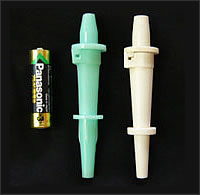
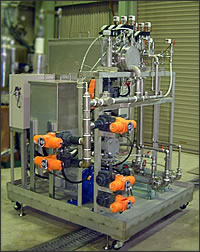
A hydrocyclone (liquid cyclone) injects treatment solution into stationary equipment to perform separation, classification, and concentration, and is an innovative separator with a very simple structure and no drive unit.
Structure of a hydrocyclone (liquid cyclone)
A suspension containing fine particles of several micrometers or more is supplied to a cylindrical container circumferentially at high speed. And as a result it starts to rotate and a centrifugal force is generated. At this time a gravitational acceleration of several tens of thousands of G is generated in the circumferential direction, and thus leading to fast sedimentation and concentration of the fine particles. The separated concentration can be freely selected by changing the supply rate (supply pressure and flow rate) and the flow ratio of the outlet. Our hydrocyclone (liquid cyclone) was designed and manufactured to classify and concentrate fine particles, and so has a small element.
THREE:This proclamation was speedily followed by the steady march of soldiers to various quarters. At one moment was heard the loud roar of innumerable voices in the full commission of outrage, and at the next the rattle of musketry and the shrieks of the wounded and dying, followed by a strange silence. The first troops who commenced the bloody duty of repression were the Northumberland militia, who had come that day by a forced march of twenty-five miles, and who were led by Colonel Holroyd against the rioters at Langdale's distillery in Holborn. A detachment of the Guards at the same time drove the mob from the possession of Blackfriars Bridge. Numbers were there killed, or were forced by the soldiers or their own fears over the parapet of the bridge, and perished in the Thames. Where the mob would not disperse, the officers now firmly gave the word of command, and the soldiers fired in platoons. Little resistance was offered; in many quarters the inhabitants, recovering their presence of mind, armed themselves, and came forth in bodies to assist the soldiers. The number of troops now assembled in and around London amounted to twenty-five thousand, and before night the whole city was as quiet¡ªfar quieter, indeed¡ªthan on ordinary occasions, for a sorrowful silence seemed to pervade it; and besides two hundred men shot in the streets, two hundred and fifty were carried to the hospitals wounded, of whom nearly one hundred soon expired. But these bore no proportion to the numbers who had fallen victims to their own excesses, or who had been buried under the ruins of falling buildings, or consumed in the flames in the stupor of intoxication. The king's decision had saved London.[83]
- Equipment costs can be reduced.
- Operating costs can be reduced.
- Maintenance costs can be reduced.
- Any change in raw material and product can be easily addressed.
- Large amounts can be treated in a small area.
- Separation and cleaning are easy because of the simple structure.
- Simplified control
- This equipment can be operated in synchronization with external devices.
- Alarm and interlock mechanism.
THREE:Besides these leading histories, this reign produced many others of great value. Amongst these[178] appeared, in 1763, a "History of England," by a lady, Catherine Macaulay, from James I. to the accession of the House of Hanover; which was followed by another series, from the Revolution to her own time. Mrs. Macaulay was a thorough-going Republican; had gone to America expressly to see and converse with Washington, and her history presented the very opposite opinions and phase of events to those of Hume. Lord Lyttelton wrote a "History of Henry II.," in by no means a popular style; and the book is now forgotten. In 1776 there was published the first volume of Lord Hailes's valuable "Annals of Scotland," of which Dr. Johnson entertained so high an opinion. Besides these may be named Macpherson's "History of Great Britain from the Restoration;" Stuart's "History of the Reformation in Scotland," and "History of Scotland from the Reformation to the Death of Queen Mary;" Whitaker's "History of Manchester;" Warner's "History of Ireland;" Leland's "History of Ireland;" Grainger's "Biographical History of England;" Ferguson's "History of the Progress and Termination of the Roman Republic;" Watson's "History of Philip II. of Spain;" Orme's "History of the British Nation in Hindostan;" Anderson's "Annals of Commerce." In 1784 Mitford published his "History of Ancient Greece," and two years later Gillies published another "History of Greece." In 1789 Pinkerton published a "History of the House of Stuart down to Queen Mary." In 1790 Boswell published his "Life of Johnson," the most interesting biography ever written; in 1796 Roscoe his "Life of Lorenzo de' Medici," and, in 1805, the "Life and Pontificate of Leo X."
- Classification and concentration for the manufacture of inorganic powder materials
- Classification of ceramic materials
- Removal of fine particles, including iron powder
- Removal of fine particles from pigments
- Removal of fine organic particles from solvents
- Separation of starch and yeast
- Removal of fine particles from high-temperature strong acid solutions
- Removal of fine particles from low-temperature solutions